
XRP's Record-Breaking Surge: Catalysts, Market Sentiment, and Institutional Adoption Driving a New Era in Crypto
 Aime Summary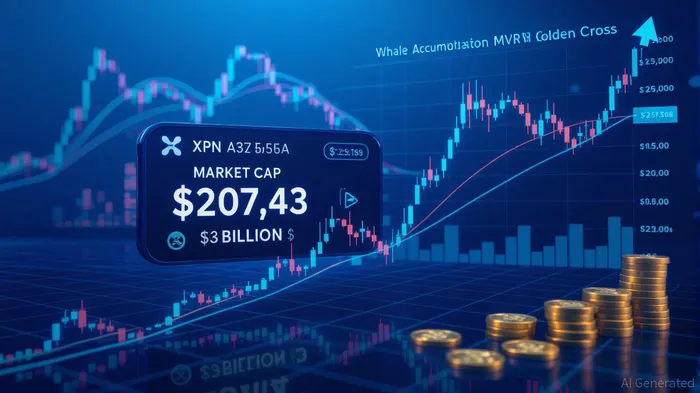
The XRP price rally of 2025 is not merely a speculative frenzy—it is a calculated response to a tectonic shift in the crypto landscape. By mid-July, XRP had pierced the $3.43 threshold, a level last seen in 2018, and secured a market capitalization of $207 billion, cementing its position as the third-largest cryptocurrency. This surge is the result of a rare convergence of regulatory clarity, institutional adoption, and on-chain fundamentals that together signal a paradigm shift in how digital assets are perceived by both Wall Street and Main Street.
Regulatory Clarity: The Legal Framework That Unlocked XRP
The U.S. House's passage of the GENIUS Act and CLARITY Act in July 2025 marked a watershed moment. These laws explicitly addressed the ambiguity surrounding XRP's status as a security, a shadow cast by the SEC's decade-long lawsuit. The CLARITY Act's distinction between securities and commodities, combined with the GENIUS Act's stablecoin transparency mandates, effectively neutralized the legal headwinds. Ripple's RLUSD stablecoin initiative, now compliant with federal guidelines, has drawn institutional interest as a low-volatility alternative to traditional stablecoins.
This regulatory tailwind has been amplified by political momentum. President Trump's endorsement of pro-innovation policies and Scott Bessent's advocacy for a “crypto-neutral” framework have signaled to investors that XRP's legal risks are receding. For context, the probability of a spot XRP ETF approval now stands at 85% on Polymarket—a metric that mirrors the optimism surrounding Bitcoin ETFs in late 2023.
Institutional Adoption: From Corporate Treasuries to Banking Ambitions
Institutional confidence in XRP has materialized in two key ways: corporate treasury allocations and Ripple's push for a U.S. banking license.
- Corporate Holdings: Companies such as VivoPowerVVPR-- and Webus have allocated $421 million to XRP treasuries, while Thumzup MediaTZUP-- (TZUP) has committed $250 million to crypto assets, with XRP as a core holding. This trend mirrors MicroStrategy's Bitcoin strategy, validating XRP as a strategic asset for long-term capital preservation.
- Banking Ambitions: Ripple's March 2025 filing for a U.S. banking license underscores its intent to bridge traditional finance and blockchain. By leveraging its xRapid and xCurrent platforms, Ripple is positioning XRP as the backbone of real-time cross-border payments, a $2.5 trillion market ripe for disruption.
The institutional narrative is further reinforced by XRP's utility. Unlike many speculative tokens, XRP's role in liquidity provision for cross-border transactions—facilitated by 150+ global banks—gives it intrinsic value. The recent tokenization of property title deeds in the UAE and partnerships with legacy financial institutions are early signs of XRP's transition from a speculative asset to a utility-driven one.
Market Sentiment: On-Chain Accumulation and Retail FOMO
The market's enthusiasm is not purely top-down. On-chain data reveals a surge in whale accumulation, with 2.2 billion XRP added to large wallets in just two weeks. This pattern mirrors Bitcoin's 2020–2021 rally, where whale activity preceded a 630% price surge. Santiment's MVRV golden cross—a rare signal indicating undervaluation—further validates this bullish narrative.
Retail adoption is also accelerating. XRP's wallet count has grown 200% year-to-date, now exceeding 7.19 million, driven by Ripple's EVM-compatible sidechain deployment. This infrastructure expansion, coupled with the ProShares XRP ETF's July 18 launch, has democratized access to a token once shunned by mainstream investors. The ETF's $1.2 billion in assets under management within its first week underscores the pent-up demand for regulated exposure to XRP.
Technical Indicators: A Breakout with Long-Term Implications
XRP's technical chart tells a story of resilience. A breakout from a multi-year symmetrical triangle in late June, followed by a 25% weekly gain, suggests a shift from range-bound trading to a trend-following phase. The RSI's overbought condition and OBV's sustained ascent indicate strong buyer participation.
Short-term targets of $3.85–$4.00 align with the 2018 high, while mid-term forecasts hinge on ETF approval. If the ProShares XRP ETF gains broad adoption—akin to BlackRock's Bitcoin ETF—XRP could test $5.50–$7.00 by late 2025. Long-term, a U.S. banking license and cross-border payment dominance could drive the price to $8–$10 by 2026–2027.
Risks and Rationality
Despite the bullish case, risks persist. Exchange inflows have risen, hinting at potential profit-taking. A failure to break the $3.85–$4.00 range could trigger a pullback to $2.90–$3.00. Broader market risks—such as Bitcoin's consolidation phase or regulatory reversals—also loom.
Investment Thesis: Timing the Wave
For investors, the key question is timing. Short-term traders may find opportunities in the ETF-driven liquidity, while long-term holders should focus on Ripple's banking license and cross-border use cases. A diversified approach—allocating 5–10% of a crypto portfolio to XRP—could balance growth and risk.
XRP's journey from legal uncertainty to a $207 billion market cap is a microcosm of crypto's evolution. Regulatory clarity, institutional trust, and on-chain strength have created a self-reinforcing cycle. For those who recognize this, XRP is not just a token—it's a glimpse into the future of finance.

Delivering real-time insights and analysis on emerging financial trends and market movements.
Latest Articles
Stay ahead of the market.
Get curated U.S. market news, insights and key dates delivered to your inbox.


AInvest
PRO
AInvest
PRO



Comments
No comments yet