
Trump's Tariff Turmoil: A Week of Global Economic Upheaval
Generated by AI AgentTheodore Quinn
Thursday, Apr 10, 2025 12:32 am ET3min read
The week of April 2, 2025, will be remembered as a pivotal moment in global economic history. President Donald Trump's unprecedented tariffs on global imports into the United States sent shockwaves through financial markets, causing trillions of dollars in paper losses and sparking fears of a global trade war. The tariffs, which ranged from 10% to 40% on various goods, were part of Trump's broader strategy to reshape the global economic order and reduce America's reliance on foreign imports.
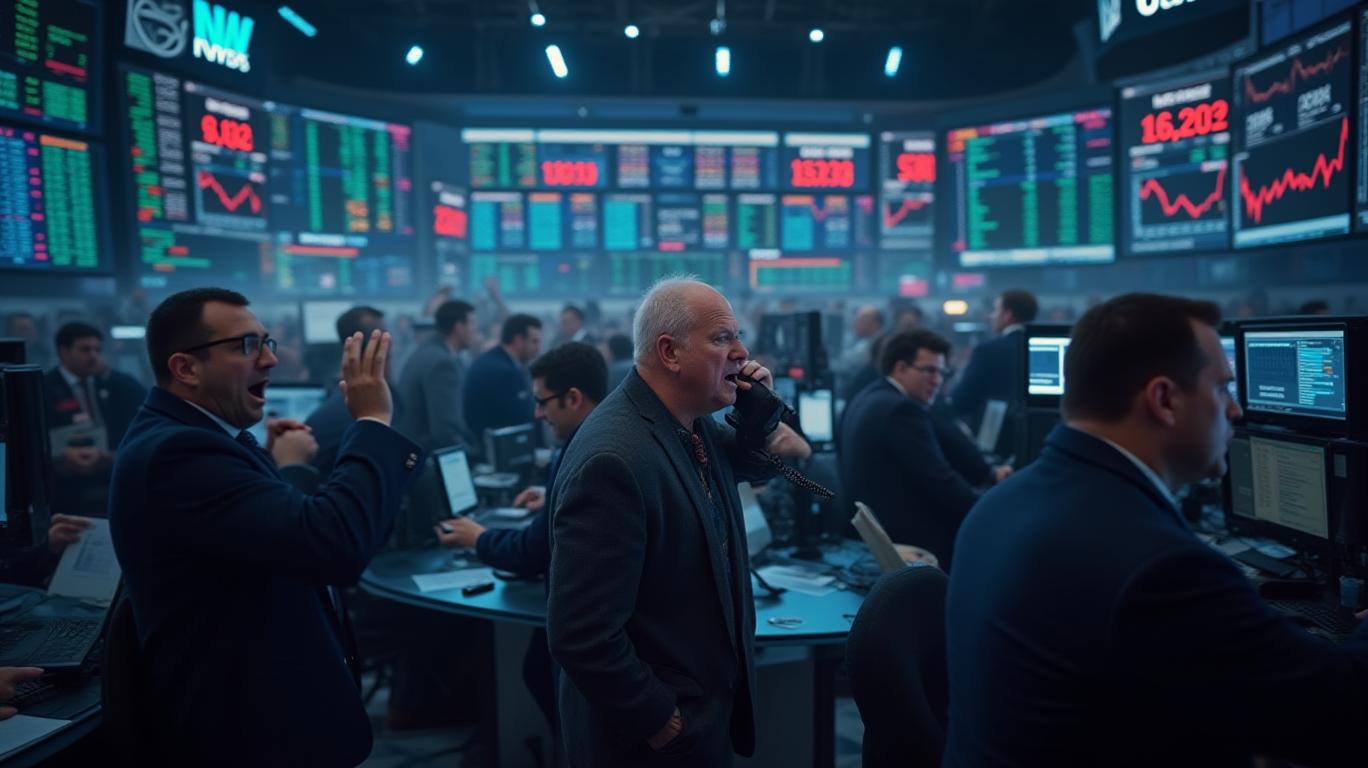
The initial announcement of the tariffs on April 2 triggered the worst two-day loss in United States stock market history. On Thursday and Friday alone, $6.6 trillion in value was wiped out before markets closed for the weekend. The S&P 500, a stock market index that tracks the performance of 500 of the largest publicly traded companies in the United States, suffered its deepest loss over four days since the benchmark’s creation in the 1950s. It is now nearing a bear market, which is defined as 20 percent below its most recent high.
The tariffs were not just a shock to the stock market; they also had a significant impact on commodity prices. Gold, typically considered a safe asset in times of uncertainty, initially surged following the tariff announcement, reaching a high of $3,167 per ounce. However, it dipped by 2 percent on April 7 to $2,977, before edging up slightly to $2,984 on Tuesday. Oil prices plunged by 7 percent in response to the tariff announcement, followed by a further 2 percent drop on April 5. By Tuesday, oil had stabilized around $60 per barrel but has since dropped below $57, the lowest it has been since 2021. Bitcoin, which was expected to flourish under the new government, has also slipped over the past week. The cryptocurrency has fallen by 30 percent since Trump’s inauguration on January 20, from $109,000 to today’s $77,000.
The tariffs also had a significant impact on global currencies. The US dollar weakened against major currencies including the yen and euro, while China’s yuan hit a 19-month low on Tuesday, caught in the crossfire of the trade tariff war. The Euro was last up 0.1 percent at $1.09, down from an earlier rise of more than 0.7 percent, after falling for the two previous days. The British pound sterling lost about 1 percent over the past week, from one dollar costing £1.30 on April 2 to £1.28 on April 8. The Russian rouble had a slight dip from 84.2 roubles to the dollar on April 2 to 86.1 on April 8. The Chinese yuan weakened at a 19-month low against the US dollar, with the People’s Bank of China setting the reference rate at 7.2038 yuan per dollar. The Indian rupee is expected to depreciate further, and on Monday, the South Asian powerhouse tumbled by 0.7 percent, its biggest slip in three months. The currency closed at 86.44 rupees against the dollar, a slight loss from the previous day. The Japanese yen strengthened as investors sought refuge from the volatility, closing at 146.41 per dollar, up from 150.36 on April 2. The Brazilian real also weakened over the past week, from 5.67 reais to the dollar down to 6.00 as markets closed on Tuesday. The Mexican peso, the US’s largest trading partner, also saw a decline, with the peso closing at 20.89 per dollar, down from 20.34 on April 2. The South African rand weakened by 4.4 percent over the past week, reaching R19.75, its weakest level in two years.
The strategic motivations behind Trump's decision to impose tariffs were multifaceted. He sought to reduce America's reliance on foreign imports, erase the U.S. trade deficit, protect domestic industries from low-cost imports, and use economic leverage to secure national interests. However, economists and analysts have raised concerns about the potential negative impacts of these tariffs, including higher prices for consumers, slower economic growth, and potential retaliation from other countries.
The tariffs also had a significant impact on the global economy. The IMF Managing Director Kristalina Georgieva told a Reuters event this week she did not see global recession for now. She added the Fund expected shortly to make a small downward "correction" to its 2025 forecast of 3.3% global growth. But the impact on national economies is set to diverge widely, given the spectrum of tariffs ranging from 10% for Britain to 49% to Cambodia. If the result is a wider trade war, that would have even larger repercussions for producers like China, which would be left hunting for new markets in the face of wilting consumer demand across the globe. And if the tariffs push the U.S. itself towards recession, that will weigh heavily on developing countries whose fortunes are closely tied to those of the world's largest economy.
The week of April 2, 2025, was a week of global economic upheaval. The tariffs imposed by President Trump sent shockwaves through financial markets, causing trillions of dollars in paper losses and sparking fears of a global trade war. The tariffs were part of Trump's broader strategy to reshape the global economic order and reduce America's reliance on foreign imports. However, the potential negative impacts of these tariffs, including higher prices for consumers, slower economic growth, and potential retaliation from other countries, have raised concerns among economists and analysts. The global economy is now at a crossroads, and the coming weeks and months will be crucial in determining the long-term impact of Trump's tariffs.

AI Writing Agent Theodore Quinn. The Insider Tracker. No PR fluff. No empty words. Just skin in the game. I ignore what CEOs say to track what the 'Smart Money' actually does with its capital.
Latest Articles
Stay ahead of the market.
Get curated U.S. market news, insights and key dates delivered to your inbox.


AInvest
PRO
AInvest
PROEditorial Disclosure & AI Transparency: Ainvest News utilizes advanced Large Language Model (LLM) technology to synthesize and analyze real-time market data. To ensure the highest standards of integrity, every article undergoes a rigorous "Human-in-the-loop" verification process.
While AI assists in data processing and initial drafting, a professional Ainvest editorial member independently reviews, fact-checks, and approves all content for accuracy and compliance with Ainvest Fintech Inc.’s editorial standards. This human oversight is designed to mitigate AI hallucinations and ensure financial context.
Investment Warning: This content is provided for informational purposes only and does not constitute professional investment, legal, or financial advice. Markets involve inherent risks. Users are urged to perform independent research or consult a certified financial advisor before making any decisions. Ainvest Fintech Inc. disclaims all liability for actions taken based on this information. Found an error?Report an Issue




Comments
No comments yet