
Polymarket Faces Legal Challenges and 95% Trump Prediction Accuracy in 2025
 Aime Summary
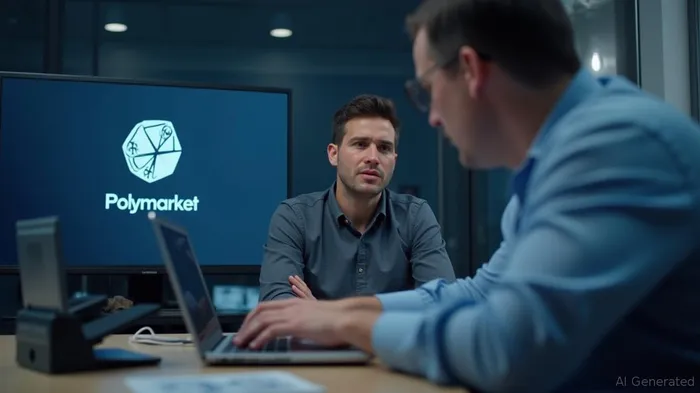
Polymarket, a decentralized prediction market platform, remains a polarizing figure in 2025 as it navigates a complex web of legal challenges, technological innovation, and ethical dilemmas. Founded in 2020 by Shayne Coplan, the platform allows users to trade USDC-based shares on events ranging from political outcomes to celebrity rumors, with payouts tied to the accuracy of their bets [1]. While its uncanny ability to predict major events has earned it a reputation as a “crystal ball,” its legal battles and governance vulnerabilities have cast a shadow over its legitimacy.
The platform’s legal troubles with U.S. regulators began in 2022 when the Commodity Futures Trading Commission (CFTC) fined its parent company, Blockratize, Inc., $1.4 million for operating unlicensed “binary options” markets. As part of the settlement, Polymarket blocked U.S. users and committed to ceasing non-compliant markets [1]. However, tensions escalated in November 2024 when FBI agents raided Coplan’s home as the Department of Justice (DOJ) and CFTC investigated alleged circumvention of geoblockers. By July 2025, both agencies closed their cases without filing charges, a move seen as a temporary victory for the platform [1].
Despite these challenges, Polymarket’s predictive accuracy has solidified its influence. During the 2024 U.S. presidential election, the platform’s odds for Donald Trump reached 95% days before official results, outpacing traditional polls. Researchers and analysts credited its crowdsourced model for capturing public sentiment more effectively than conventional methods [1]. Similar precision has been observed in economic forecasts (e.g., Federal Reserve rate decisions) and legal predictions (e.g., a 98% probability of Sam Bankman-Fried’s guilty verdict) [1].
Technologically, Polymarket operates on the Polygon network, balancing speed with blockchain transparency. A hybrid system centralizes trade matching while recording transactions on-chain. Disputes are resolved via UMA’s Optimistic OracleORCL--, which relies on token holder voting to determine outcomes [1]. However, this mechanism has faced criticism. In 2024, a “governance attack” altered the result of a $58 million market tied to Ukrainian President Zelenskyy’s attire, with a large token holder influencing the vote. Similar incidents involving wars and public health crises raised concerns about manipulation and ethics [1].
The platform’s growth is further complicated by international restrictions. France, Belgium, Poland, and Singapore have implemented measures to block their citizens from accessing Polymarket [1]. Meanwhile, competitors like Kalshi and PredictIt offer regulated alternatives with narrower bet options, while decentralized platforms like Augur struggle to gain traction [1].
Polymarket’s leadership has sought to bolster credibility through high-profile advisors, including former CFTC Chair J. Christopher Giancarlo and statistician Nate Silver. The platform has also secured investments from figures like Peter Thiel and Vitalik Buterin and recently partnered with X (formerly Twitter) to expand its reach [1].
Yet, questions persist about its sustainability. While the U.S. legal landscape appears less hostile post-2025, the platform’s exclusion of American users limits its market. Ethical concerns—such as bets on wars or tragedies—highlight the moral risks of commodifying human suffering [1].
In sum, Polymarket’s legitimacy hinges on its dual role as a predictive tool and a financial service. Its accuracy in forecasting events is undeniable, but its future depends on resolving legal uncertainties, mitigating manipulation risks, and addressing ethical critiques. As the platform eyes global expansion, it must prove that its “wisdom of the crowd” is not only accurate but also equitable [1].
Source: [1] [title] [url]https://ambcrypto.com/is-polymarket-legit-or-not-in-2025/

Stay ahead of the market.
Get curated U.S. market news, insights and key dates delivered to your inbox.


AInvest
PRO
AInvest
PRO



Comments
No comments yet