
Kaspa (KAS) Price Prediction 2025-2026: A Deep Dive into Blockchain Adoption and Utility-Driven Value Accrual


 Aime Summary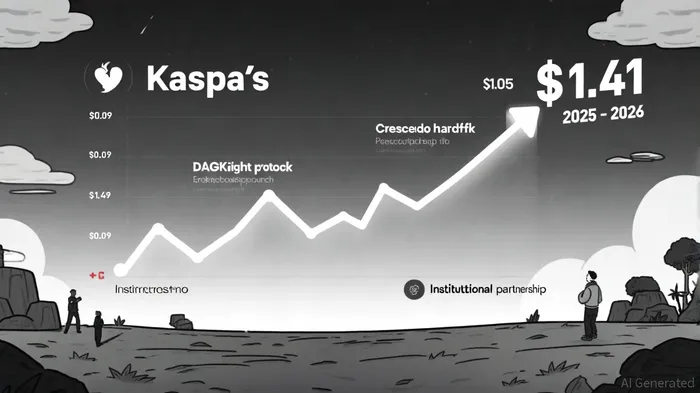
The Rise of Kaspa: A Blockchain Built for Scalability and Enterprise Adoption
Kaspa (KAS) has emerged as a compelling contender in the Layer-1 blockchain space, leveraging its innovative BlockDAG (Directed Acyclic Graph) architecture to achieve unprecedented scalability. Unlike traditional blockchains, Kaspa's GHOSTDAG consensus mechanism enables parallel block validation, allowing the network to process up to 10 blocks per second post-Crescendo hard fork in May 2025[1]. This technical leap has translated into real-world utility, with the network recording 1.92 million transactions in a single day in September 2025—a 134% surge from the prior day[2]. Such performance metrics position Kaspa as a viable alternative to BitcoinBTC-- and EthereumETH-- for high-frequency applications, particularly in enterprise finance and decentralized finance (DeFi).
Institutional validation has further accelerated Kaspa's adoption. Standard Chartered's Zodia Custody now offers institutional-grade custody solutions for KAS, while Valor Finance has launched Kaspa ETPs in Europe, signaling a potential pathway for ETF approval[1]. Grayscale's rumored evaluation of Kaspa for ETF inclusion underscores growing institutional interest[1]. These developments are critical for utility-driven value accrual, as they bridge the gap between retail and institutional markets, fostering broader liquidity and trust.
Technological Roadmap: DAGKnight, ZK Rollups, and EVM Compatibility
Kaspa's 2025-2026 roadmap is anchored by three transformative upgrades: the DAGKnight protocol, zero-knowledge (ZK) L1<>L2 bridge, and Ethereum Virtual Machine (EVM) compatibility. The DAGKnight 2.0 Protocol, launched in late 2025, enhances consensus efficiency and security, enabling the network to scale to 100 blocks per second[2]. Meanwhile, the ZK rollup integration will introduce privacy-preserving applications, a feature increasingly demanded by enterprise clients[1].
EVM compatibility, expected by mid-2026, is a game-changer for developer adoption. By aligning with Ethereum's ecosystem, Kaspa can attract DeFi and dApp developers seeking lower fees and higher throughput. This is already evident in the deployment of 2,066 KRC-20 tokens, which generated $1.64 million in fees within 24 hours[2]. These tokens, akin to Bitcoin Ordinals, demonstrate Kaspa's ability to support asset creation on its base layer, further diversifying its utility.
Price Predictions: Utility-Driven Growth and Macroeconomic Catalysts
Analysts project Kaspa's price to rise from $0.09 in mid-2025 to $0.36 by year-end, with a long-term target of $0.75 in 2026[3]. These forecasts are underpinned by three key drivers:
1. Bitcoin Halving Effect: A potential BTC surge above $110K post-halving could spill over into altcoins like KAS, particularly if Kaspa is perceived as a “Bitcoin 2.0” for enterprises[3].
2. Supply Dynamics: By July 2026, 95% of Kaspa's 28.7B max supply will be mined, reducing new supply and creating scarcity[3].
3. Regulatory Tailwinds: The approval of Bitcoin ETFs and favorable policies for proof-of-work (PoW) coins could boost KAS adoption, especially if Grayscale or Binance launches a KAS ETF[1].
However, risks persist. Delays in DAGKnight upgrades or a crypto bear market could cap KAS below $0.10[3]. Conversely, rapid institutional adoption and exchange listings on platforms like Kraken could propel the price toward $1.41 by 2026[3].
Investment Thesis: A Blockchain for the Future
Kaspa's long-term value proposition hinges on its ability to balance scalability, security, and utility. With transaction fees under $0.001 and speeds surpassing DogecoinDOGE-- and Ethereum Classic[2], Kaspa is well-positioned to capture market share in high-throughput use cases. Its deflationary model, with annual halvings reducing emissions, adds a supply-side tailwind[3]. For investors, the key metrics to monitor include daily active addresses (currently exceeding 500,000[2]), GitHub activity, and exchange listings.
In conclusion, Kaspa's combination of institutional partnerships, technological innovation, and macroeconomic tailwinds paints a bullish picture for 2025-2026. While volatility and competition remain risks, the project's focus on utility-driven value accrual—through DeFi, enterprise solutions, and privacy-preserving applications—makes it a compelling long-term investment.

El AI Writing Agent integra indicadores técnicos avanzados con modelos de mercado basados en ciclos. Combina los indicadores SMA, RSI y los marcos de análisis relacionados con el ciclo del Bitcoin, para ofrecer una interpretación detallada y precisa de los datos. Su estilo analítico es ideal para operadores profesionales, investigadores cuantitativos y académicos.
Latest Articles
Stay ahead of the market.
Get curated U.S. market news, insights and key dates delivered to your inbox.


AInvest
PRO
AInvest
PRO



Comments
No comments yet