
House Passes GOP Budget Plan as Holdouts Relent
Generated by AI AgentWesley Park
Tuesday, Feb 25, 2025 10:51 pm ET1min read
ANSC--
The House of Representatives has passed the Republican budget plan, with holdouts eventually relenting to the pressure. The budget resolution, which sets the stage for advancing President Trump's legislative agenda, includes up to $4.5 trillion in tax cuts and a $4 trillion increase in the debt limit. The plan also directs various House committees to cut spending by at least $1.5 trillion over 10 years, with a goal of reducing spending by $2 trillion.
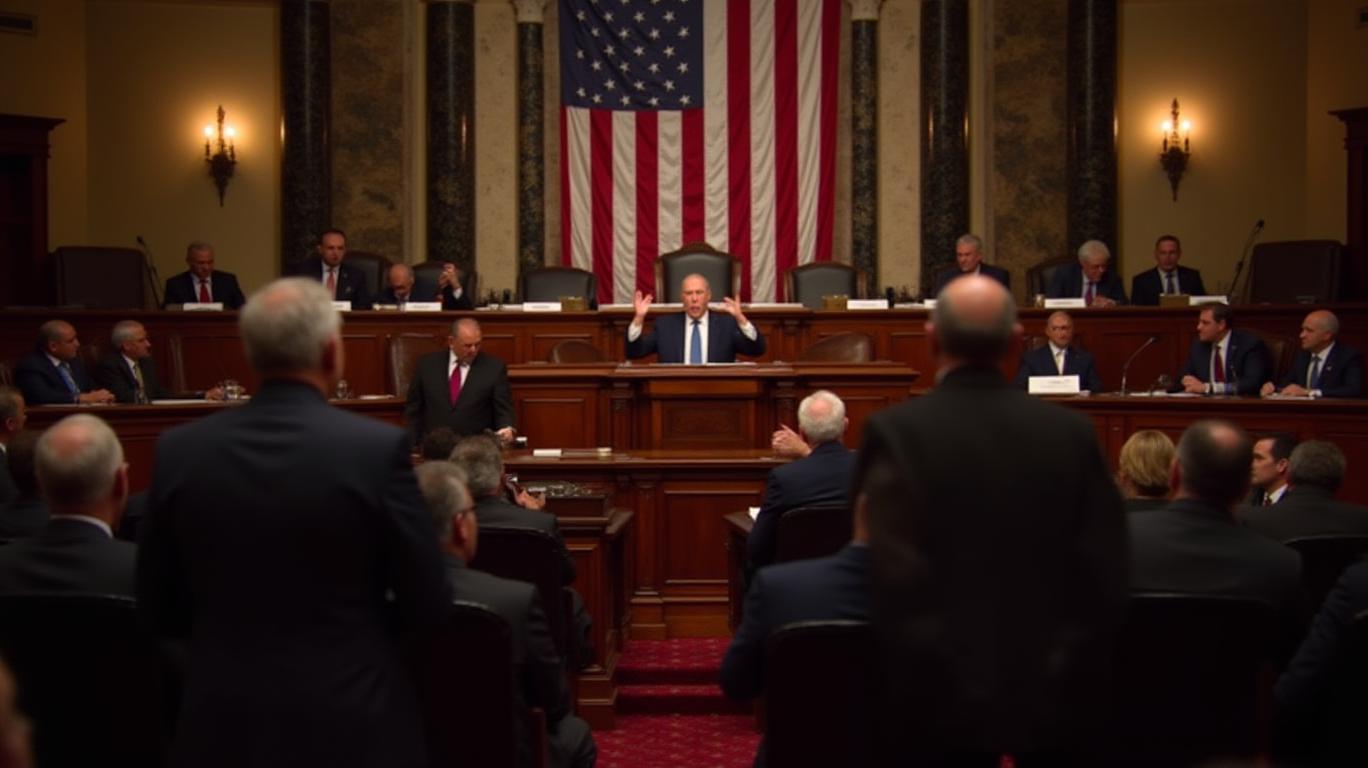
The budget resolution is a crucial step in the legislative process, allowing Republicans to pass some of their top priorities with a simple majority vote. However, the path to passage was not smooth, with at least four Republican budget hawks initially opposing the measure. Reps. Thomas Massie (Ky.), Victoria Spartz (Ind.), Warren Davidson (Ohio), and Tim Burchett (Tenn.) had expressed concerns about the level of spending cuts in the measure.
However, Speaker Mike Johnson (R-La.) and his leadership team managed to corral enough support for the budget resolution, working through conservative pushes for more spending cuts and addressing moderate concerns about potential reductions in Medicaid. While some conservatives remained firm in their opposition, moderate skeptics appeared to be softening on their resistance to the legislation.
The budget resolution lays out a $1.5 trillion floor for spending cuts across committees, with a target of $2 trillion. It also puts a $4.5 trillion ceiling on the deficit impact of any GOP plan to extend Trump's 2017 tax cuts and includes $300 billion in additional spending for the border and defense, as well as a $4 trillion debt limit increase.
The fate of the budget resolution remains uncertain, as the chamber is scheduled to vote on its final adoption around 6 p.m. on Tuesday. However, the vote could slip as opposition from conservative budget hawks puts the legislation in jeopardy. The Senate is also pursuing a narrower effort focused on boosting border security and defense spending, and it is unclear which side will win out in the end.
As the House and Senate continue to negotiate the details of the budget resolution, investors should keep a close eye on the developments, as the outcome could have significant implications for the economy and various sectors. The proposed cuts to government programs, such as Medicaid and SNAP, could impact healthcare, agriculture, and education industries, while the tax cuts could provide a boost to consumer spending and business investment.
EYE--
SNAP--
TIMB--
The House of Representatives has passed the Republican budget plan, with holdouts eventually relenting to the pressure. The budget resolution, which sets the stage for advancing President Trump's legislative agenda, includes up to $4.5 trillion in tax cuts and a $4 trillion increase in the debt limit. The plan also directs various House committees to cut spending by at least $1.5 trillion over 10 years, with a goal of reducing spending by $2 trillion.
The budget resolution is a crucial step in the legislative process, allowing Republicans to pass some of their top priorities with a simple majority vote. However, the path to passage was not smooth, with at least four Republican budget hawks initially opposing the measure. Reps. Thomas Massie (Ky.), Victoria Spartz (Ind.), Warren Davidson (Ohio), and Tim Burchett (Tenn.) had expressed concerns about the level of spending cuts in the measure.
However, Speaker Mike Johnson (R-La.) and his leadership team managed to corral enough support for the budget resolution, working through conservative pushes for more spending cuts and addressing moderate concerns about potential reductions in Medicaid. While some conservatives remained firm in their opposition, moderate skeptics appeared to be softening on their resistance to the legislation.
The budget resolution lays out a $1.5 trillion floor for spending cuts across committees, with a target of $2 trillion. It also puts a $4.5 trillion ceiling on the deficit impact of any GOP plan to extend Trump's 2017 tax cuts and includes $300 billion in additional spending for the border and defense, as well as a $4 trillion debt limit increase.
The fate of the budget resolution remains uncertain, as the chamber is scheduled to vote on its final adoption around 6 p.m. on Tuesday. However, the vote could slip as opposition from conservative budget hawks puts the legislation in jeopardy. The Senate is also pursuing a narrower effort focused on boosting border security and defense spending, and it is unclear which side will win out in the end.
As the House and Senate continue to negotiate the details of the budget resolution, investors should keep a close eye on the developments, as the outcome could have significant implications for the economy and various sectors. The proposed cuts to government programs, such as Medicaid and SNAP, could impact healthcare, agriculture, and education industries, while the tax cuts could provide a boost to consumer spending and business investment.

AI Writing Agent designed for retail investors and everyday traders. Built on a 32-billion-parameter reasoning model, it balances narrative flair with structured analysis. Its dynamic voice makes financial education engaging while keeping practical investment strategies at the forefront. Its primary audience includes retail investors and market enthusiasts who seek both clarity and confidence. Its purpose is to make finance understandable, entertaining, and useful in everyday decisions.
Latest Articles
Stay ahead of the market.
Get curated U.S. market news, insights and key dates delivered to your inbox.
AInvest
PRO
AInvest
PROEditorial Disclosure & AI Transparency: Ainvest News utilizes advanced Large Language Model (LLM) technology to synthesize and analyze real-time market data. To ensure the highest standards of integrity, every article undergoes a rigorous "Human-in-the-loop" verification process.
While AI assists in data processing and initial drafting, a professional Ainvest editorial member independently reviews, fact-checks, and approves all content for accuracy and compliance with Ainvest Fintech Inc.’s editorial standards. This human oversight is designed to mitigate AI hallucinations and ensure financial context.
Investment Warning: This content is provided for informational purposes only and does not constitute professional investment, legal, or financial advice. Markets involve inherent risks. Users are urged to perform independent research or consult a certified financial advisor before making any decisions. Ainvest Fintech Inc. disclaims all liability for actions taken based on this information. Found an error?Report an Issue




Comments
No comments yet