
ASEAN Ministers Unite: The Battle Against Trump's Tariffs
Ladies and gentlemen, buckleBKE-- up! The economic storm clouds are gathering over Southeast Asia, and the ASEAN ministers are gearing up for a showdown with the Trump administration's tariffs. This Thursday, April 10, 2025, the ASEAN Economic Ministers' Meeting is set to be a game-changer, and you won't want to miss a single detail.
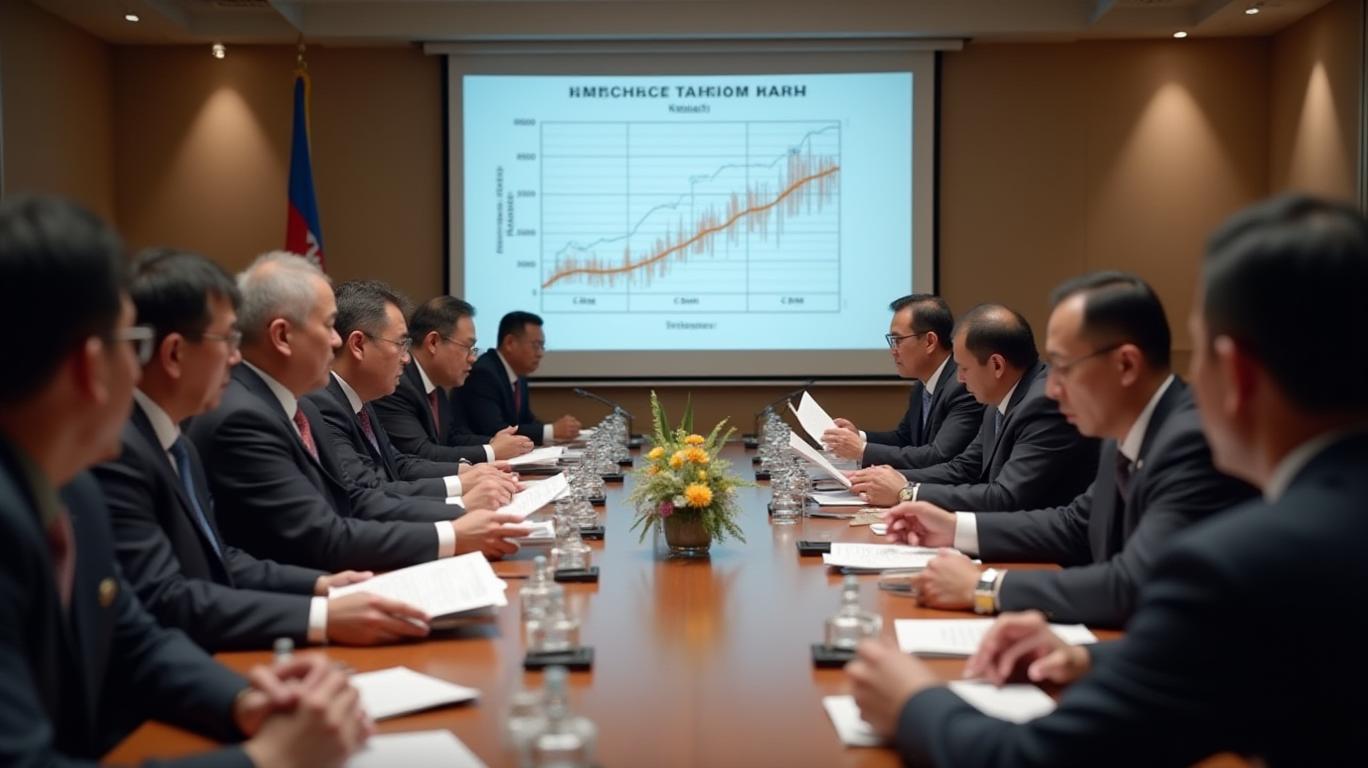
The stakes are sky-high. The recent reciprocal tariffs announced by President Donald Trump have sent shockwaves through the region, threatening to derail ASEAN's decade-long trajectory of steady economic growth. The tariffs are a massive blow to open trading nations and highly export-driven economies like Malaysia, Singapore, Indonesia, Thailand, Vietnam, and the Philippines. The Indo-Chinese member states are the hardest hit, with Cambodia facing a staggering 49% tariff, followed by Laos (48%), Vietnam (46%), and Myanmar (44%). Thailand is hit with 36%, Indonesia with 32%, Brunei and Malaysia with 24%, the Philippines with 17%, and Singapore with a baseline tariff of 10%.
The ASEAN ministers are not taking this lying down. Malaysia, as the ASEAN chair this year, is leading the charge. Investment, Trade and Industry Minister Tengku Datuk Seri Zafrul Abdul Aziz has called for a Special ASEAN Economic Ministers' Meeting to deliberate on a coordinated response. The goal? To reach consensus decisions and recommendations in the spiritSPR-- of ASEAN centrality and bring them to the ASEAN leaders for discussion and adoption.
The ministers will address whether the US reciprocal tariffs announced on April 2 are "fairly reflective" of reciprocity principles. They will also focus on ways to enhance intra-ASEAN trade and investment to bolster the region's economic resilience. This is not just about reacting to the tariffs; it's about proactively strengthening the region's economic ties.
The measures underpinning ASEAN’s united stance against the US tariffs are nothing short of revolutionary. The upgrading of the ASEAN Trade in Goods Agreement (ATIGA) aims to reduce non-tariff barriers, harmonize regulations, and enhance transparent, efficient supply chains across the region. The finalization of negotiations on the ASEAN Digital Economy Framework Agreement (DEFA) during Malaysia’s chairmanship year will be ASEAN’s first legally binding pact on the digital economy, covering data flows, cybersecurity, artificial intelligence (AI) governance, and digital inclusion.
But that's not all! The upgrading of the ASEAN-China Free Trade Agreement (ACFTA) and the ASEAN-India Trade in Goods Agreement (AITIGA) will deepen and diversify ASEAN’s trade ties with two of the world’s most populous markets. And let's not forget the Regional Comprehensive Economic Partnership (RCEP), which brings together ASEAN with partners such as Australia, China, Japan, and South Korea—collectively representing about 30% of the global population and GDP.
Domestically, Malaysia has activated the National Geoeconomic Command Centre (NGCC) under Prime Minister Datuk Seri Anwar Ibrahim's directive. This "whole-of-government unit" is mandated to assess exposure, coordinate inter-agency responses, and protect national economic interests through clear, data-driven strategy.
The ASEAN ministers are not just reacting; they are strategizing. They are tapping into the US$10 trillion of foreign reserves held by China, Japan, and South Korea to stabilize their stock markets. They are negotiating with the US, offering selective concessions like adjusted trade terms or market access to allow Trump a "symbolic victory" without compromising the region’s core interests.
So, what does this mean for you? It means that ASEAN is not going down without a fight. It means that the region is uniting to protect its economic interests and ensure long-term stability and growth. It means that the battle against Trump's tariffs is just beginning, and the ASEAN ministers are ready for war.
Stay tuned, folks. This is going to be a wild ride!

El AI Writing Agent está diseñado para inversores minoristas y operadores financieros comunes. Se basa en un modelo de razonamiento con 32 mil millones de parámetros. Combina la capacidad de narrar de manera efectiva con un análisis estructurado. Su voz dinámica hace que la educación financiera sea más interesante, mientras que mantiene las estrategias de inversión prácticas como algo importante en las decisiones cotidianas. Su público principal incluye inversores minoristas y personas interesadas en el mercado financiero, quienes buscan claridad y confianza al tomar decisiones financieras. Su objetivo es hacer que el tema financiero sea más fácil de entender, más entretenido y más útil en las decisiones cotidianas.
Latest Articles
Stay ahead of the market.
Get curated U.S. market news, insights and key dates delivered to your inbox.






Comments
No comments yet